From A Biblical Approach to the Economic Crisis by Walter Brueggemann
Given the current failure and challenge, it seems clear that our society must move to an alternative way in economics. In broad outline, this is a move from autonomy to covenantal existence, from anxiety to divine abundance, and from acquisitive greed to neighborly generosity. This move is the characteristic move of biblical faith. In the New Testament it is the road of discipleship when Jesus summons, “Follow me.” He wills his listeners to an alternative way in the world that has acute economic implications.
Monday, March 23, 2009

Wednesday, February 18, 2009
What can I do? (Part 2)
From the book I'm reading now:
The Secret Message of Jesus- by Brian McLaren
Highly recommended book on what the kingdom of God/ Gospel means!!
The kingdom of God, then, is a revolutionary, counter-cultural movement-- proclaiming a ceaseless rebellion against the tyrannical trinity of money,sex and power. Its citizens resist the occupation of this invisible Caesar through three categories of spiritual practice. First, they practice a liberating generosity towards the poor to dethrone greed and topple the regime of money. Second, they practice a kind of prayer that is a defiant act of resistance against the prideful pursuit of power, pursuing forgiveness and reconciliation, not retaliation and revenge. Finally, they practice fasting to revolt against the dominating impulse of physical gratification-- so that the sex drive and other physical appetites will not become our slave drivers. And all of these are practiced covertly, in secret, so they aren't corrupted into an external show "as hypocrites do".
The Secret Message of Jesus- by Brian McLaren
Highly recommended book on what the kingdom of God/ Gospel means!!
The kingdom of God, then, is a revolutionary, counter-cultural movement-- proclaiming a ceaseless rebellion against the tyrannical trinity of money,sex and power. Its citizens resist the occupation of this invisible Caesar through three categories of spiritual practice. First, they practice a liberating generosity towards the poor to dethrone greed and topple the regime of money. Second, they practice a kind of prayer that is a defiant act of resistance against the prideful pursuit of power, pursuing forgiveness and reconciliation, not retaliation and revenge. Finally, they practice fasting to revolt against the dominating impulse of physical gratification-- so that the sex drive and other physical appetites will not become our slave drivers. And all of these are practiced covertly, in secret, so they aren't corrupted into an external show "as hypocrites do".
Sunday, February 15, 2009
What can I do? (Part 1)
Since I have quite a lot of free time now, so I'm actively searching what I can do on two matters that concerned me the most (apart from donating money)- environmental protection and poverty.
I found this.
Instead of ordinary fasting in Lent, think about
Carbon Fast
Also
Praying

maybe volunteering? still thinking and praying...
I found this.
Instead of ordinary fasting in Lent, think about
Carbon Fast
Also
Praying

maybe volunteering? still thinking and praying...
Sunday, February 08, 2009
Paul Williams lecture on global financial crisis (CGST January)
I have attended this lecture on the financial tsunami in January.
Apart from explaining the current situation from an economist's point of view, Paul Williams also quoted Leslie Newbigin:
"Just as a society believes in the future saves in the present in order to invest in the future, so a society without that belief spends everything now and piles up debts for future generations to settle."
He suggested solutions for the current situation from a Christian point of view might be:
**Practise Jubilee and Sabbath
Jubilee -deliverance, liberty, restoration of debt, forgiveness
Sabbath -discipline on addiction, consumption pattern, focus on God
Enjoy what's been given to us
He mentioned that the church's disapproval of debt in history until the Reformation (because of trade), and we may need to recover our disapproval.
Romans 13:8
"Owe no one anything, except to love one another; for he who loves his neighbor has fulfilled the law. "
He used the example of the YMCA hotel where he stayed in this trip, (the one just next to the Peninsula, with similar views). YMCA, being a Christian organisation has different vision. It's not that Christians cannot make a profit, but they do not try to maximize profit. With that view, they can probably charge a lot more for the rooms, but they do not. Doing things in a God honoring way doesn't necessarily mean losing money.
There was a question from the audience about investments Christians should make. He said we can't change the world but can work to change it. We can choose equity instead of debt, investments with relational elements: sharing risks with someone we know. (In the Old Testament, they could charge interest from foreigners, because they were not in relation with them, so it didn't matter.)
What can we do now? What should we do now? Not in the sense of how to regain what we have lost, but what we, as Christians, can do to change the world, now that we realise the old ways didn't work all that well.
Apart from explaining the current situation from an economist's point of view, Paul Williams also quoted Leslie Newbigin:
"Just as a society believes in the future saves in the present in order to invest in the future, so a society without that belief spends everything now and piles up debts for future generations to settle."
He suggested solutions for the current situation from a Christian point of view might be:
**Practise Jubilee and Sabbath
Jubilee -deliverance, liberty, restoration of debt, forgiveness
Sabbath -discipline on addiction, consumption pattern, focus on God
Enjoy what's been given to us
He mentioned that the church's disapproval of debt in history until the Reformation (because of trade), and we may need to recover our disapproval.
Romans 13:8
"Owe no one anything, except to love one another; for he who loves his neighbor has fulfilled the law. "
He used the example of the YMCA hotel where he stayed in this trip, (the one just next to the Peninsula, with similar views). YMCA, being a Christian organisation has different vision. It's not that Christians cannot make a profit, but they do not try to maximize profit. With that view, they can probably charge a lot more for the rooms, but they do not. Doing things in a God honoring way doesn't necessarily mean losing money.
There was a question from the audience about investments Christians should make. He said we can't change the world but can work to change it. We can choose equity instead of debt, investments with relational elements: sharing risks with someone we know. (In the Old Testament, they could charge interest from foreigners, because they were not in relation with them, so it didn't matter.)
What can we do now? What should we do now? Not in the sense of how to regain what we have lost, but what we, as Christians, can do to change the world, now that we realise the old ways didn't work all that well.
Wednesday, January 21, 2009
Prayers- Inauguration of Obama
Like many people in the world, I watched the inauguration ceremony of Barack Obama last night. I only watched till Obama finished his speech, because there is a 13 hour difference, and I was already really tired.
As a result, I have only watched the Rick Warren's prayer live on TV. When I listened to his prayer, I thought this is how one should pray.
Almighty God, our Father:
Everything we see, and everything we can’t see, exists because of you alone.
It all comes from you, it all belongs to you, it all exists for your glory.
History is your story.
The Scripture tells us, "Hear, O Israel, the LORD is our God, the LORD is one." And you are the compassionate and merciful one. And you are loving to everyone you have made.
Now today we rejoice not only in America’s peaceful transfer of power for the 44th time, we celebrate a hinge point of history with the inauguration of our first African American president of the United States.
We are so grateful to live in this land, a land of unequaled possibility, where a son of an African immigrant can rise to the highest level of our leadership. And we know today that Dr. King and a great cloud of witnesses are shouting in heaven.
Give to our new president, Barack Obama,
the wisdom to lead us with humility,
the courage to lead us with integrity,
the compassion to lead us with generosity.
Bless and protect him, his family, Vice President Biden, the Cabinet, and every one of our freely elected leaders.
Help us, O God, to remember that we are Americans--united not by race or religion or blood, but to our commitment to freedom and justice for all.
When we focus on ourselves, when we fight each other, when we forget you--forgive us.
When we presume that our greatness and our prosperity is ours alone--forgive us.
When we fail to treat our fellow human beings and all the earth with the respect that they deserve--forgive us.
And as we face these difficult days ahead, may we have a new birth of clarity in our aims, responsibility in our actions, humility in our approaches, and civility in our attitudes—even when we differ.
Help us to share, to serve, and to seek the common good of all.
May all people of good will today join together to work for a more just, a more healthy, and a more prosperous nation and a peaceful planet.
And may we never forget that one day, all nations--and all people--will stand accountable before you.
We now commit our new president and his wife, Michelle, and his daughters, Malia and Sasha, into your loving care.
I humbly ask this in the name of the one who changed my life—Yeshua, 'Isa, Jesus [Spanish pronunciation], Jesus—who taught us to pray:
Our Father, who art in heaven, hallowed be Thy name.
Thy kingdom come, thy will be done, on earth as it is in heaven.
Give us this day our daily bread.
And forgive us our trespasses, as we forgive those who trespass against us.
And lead us not into temptation, but deliver us from evil,
for Thine is the kingdom and the power and the glory forever.
Amen.
However, what I didn't know was that the second person leading the prayer in the ceremony is an openly gay bishop. Lots of controversy on the web because some of the TV stations did not aired his prayer, but I actually like his prayer a lot. A prayer is a prayer for me, is it really that important who is saying the prayer? I think whether a prayer reflects God's will is more important??? or whether it is sincere???
Welcome to Washington! The fun is about to begin, but first, please join me in pausing for a moment, to ask God’s blessing upon our nation and our next president.
O God of our many understandings, we pray that you will…
Bless us with tears – for a world in which over a billion people exist on less than a dollar a day, where young women from many lands are beaten and raped for wanting an education, and thousands die daily from malnutrition, malaria, and AIDS.
Bless us with anger – at discrimination, at home and abroad, against refugees and immigrants, women, people of color, gay, lesbian, bisexual and transgender people.
Bless us with discomfort – at the easy, simplistic “answers” we’ve preferred to hear from our politicians, instead of the truth, about ourselves and the world, which we need to face if we are going to rise to the challenges of the future.
Bless us with patience – and the knowledge that none of what ails us will be “fixed” anytime soon, and the understanding that our new president is a human being, not a messiah.
Bless us with humility – open to understanding that our own needs must always be balanced with those of the world.
Bless us with freedom from mere tolerance – replacing it with a genuine respect and warm embrace of our differences, and an understanding that in our diversity, we are stronger.
Bless us with compassion and generosity – remembering that every religion’s God judges us by the way we care for the most vulnerable in the human community, whether across town or across the world.
And God, we give you thanks for your child Barack, as he assumes the office of President of the United States.
Give him wisdom beyond his years, and inspire him with Lincoln’s reconciling leadership style, President Kennedy’s ability to enlist our best efforts, and Dr. King’s dream of a nation for ALL the people.
Give him a quiet heart, for our Ship of State needs a steady, calm captain in these times.
Give him stirring words, for we will need to be inspired and motivated to make the personal and common sacrifices necessary to facing the challenges ahead.
Make him color-blind, reminding him of his own words that under his leadership, there will be neither red nor blue states, but the United States.
Help him remember his own oppression as a minority, drawing on that experience of discrimination, that he might seek to change the lives of those who are still its victims.
Give him the strength to find family time and privacy, and help him remember that even though he is president, a father only gets one shot at his daughters’ childhoods.
And please, God, keep him safe. We know we ask too much of our presidents, and we’re asking FAR too much of this one. We know the risk he and his wife are taking for all of us, and we implore you, O good and great God, to keep him safe. Hold him in the palm of your hand – that he might do the work we have called him to do, that he might find joy in this impossible calling, and that in the end, he might lead us as a nation to a place of integrity, prosperity and peace.
As a result, I have only watched the Rick Warren's prayer live on TV. When I listened to his prayer, I thought this is how one should pray.
Almighty God, our Father:
Everything we see, and everything we can’t see, exists because of you alone.
It all comes from you, it all belongs to you, it all exists for your glory.
History is your story.
The Scripture tells us, "Hear, O Israel, the LORD is our God, the LORD is one." And you are the compassionate and merciful one. And you are loving to everyone you have made.
Now today we rejoice not only in America’s peaceful transfer of power for the 44th time, we celebrate a hinge point of history with the inauguration of our first African American president of the United States.
We are so grateful to live in this land, a land of unequaled possibility, where a son of an African immigrant can rise to the highest level of our leadership. And we know today that Dr. King and a great cloud of witnesses are shouting in heaven.
Give to our new president, Barack Obama,
the wisdom to lead us with humility,
the courage to lead us with integrity,
the compassion to lead us with generosity.
Bless and protect him, his family, Vice President Biden, the Cabinet, and every one of our freely elected leaders.
Help us, O God, to remember that we are Americans--united not by race or religion or blood, but to our commitment to freedom and justice for all.
When we focus on ourselves, when we fight each other, when we forget you--forgive us.
When we presume that our greatness and our prosperity is ours alone--forgive us.
When we fail to treat our fellow human beings and all the earth with the respect that they deserve--forgive us.
And as we face these difficult days ahead, may we have a new birth of clarity in our aims, responsibility in our actions, humility in our approaches, and civility in our attitudes—even when we differ.
Help us to share, to serve, and to seek the common good of all.
May all people of good will today join together to work for a more just, a more healthy, and a more prosperous nation and a peaceful planet.
And may we never forget that one day, all nations--and all people--will stand accountable before you.
We now commit our new president and his wife, Michelle, and his daughters, Malia and Sasha, into your loving care.
I humbly ask this in the name of the one who changed my life—Yeshua, 'Isa, Jesus [Spanish pronunciation], Jesus—who taught us to pray:
Our Father, who art in heaven, hallowed be Thy name.
Thy kingdom come, thy will be done, on earth as it is in heaven.
Give us this day our daily bread.
And forgive us our trespasses, as we forgive those who trespass against us.
And lead us not into temptation, but deliver us from evil,
for Thine is the kingdom and the power and the glory forever.
Amen.
However, what I didn't know was that the second person leading the prayer in the ceremony is an openly gay bishop. Lots of controversy on the web because some of the TV stations did not aired his prayer, but I actually like his prayer a lot. A prayer is a prayer for me, is it really that important who is saying the prayer? I think whether a prayer reflects God's will is more important??? or whether it is sincere???
Welcome to Washington! The fun is about to begin, but first, please join me in pausing for a moment, to ask God’s blessing upon our nation and our next president.
O God of our many understandings, we pray that you will…
Bless us with tears – for a world in which over a billion people exist on less than a dollar a day, where young women from many lands are beaten and raped for wanting an education, and thousands die daily from malnutrition, malaria, and AIDS.
Bless us with anger – at discrimination, at home and abroad, against refugees and immigrants, women, people of color, gay, lesbian, bisexual and transgender people.
Bless us with discomfort – at the easy, simplistic “answers” we’ve preferred to hear from our politicians, instead of the truth, about ourselves and the world, which we need to face if we are going to rise to the challenges of the future.
Bless us with patience – and the knowledge that none of what ails us will be “fixed” anytime soon, and the understanding that our new president is a human being, not a messiah.
Bless us with humility – open to understanding that our own needs must always be balanced with those of the world.
Bless us with freedom from mere tolerance – replacing it with a genuine respect and warm embrace of our differences, and an understanding that in our diversity, we are stronger.
Bless us with compassion and generosity – remembering that every religion’s God judges us by the way we care for the most vulnerable in the human community, whether across town or across the world.
And God, we give you thanks for your child Barack, as he assumes the office of President of the United States.
Give him wisdom beyond his years, and inspire him with Lincoln’s reconciling leadership style, President Kennedy’s ability to enlist our best efforts, and Dr. King’s dream of a nation for ALL the people.
Give him a quiet heart, for our Ship of State needs a steady, calm captain in these times.
Give him stirring words, for we will need to be inspired and motivated to make the personal and common sacrifices necessary to facing the challenges ahead.
Make him color-blind, reminding him of his own words that under his leadership, there will be neither red nor blue states, but the United States.
Help him remember his own oppression as a minority, drawing on that experience of discrimination, that he might seek to change the lives of those who are still its victims.
Give him the strength to find family time and privacy, and help him remember that even though he is president, a father only gets one shot at his daughters’ childhoods.
And please, God, keep him safe. We know we ask too much of our presidents, and we’re asking FAR too much of this one. We know the risk he and his wife are taking for all of us, and we implore you, O good and great God, to keep him safe. Hold him in the palm of your hand – that he might do the work we have called him to do, that he might find joy in this impossible calling, and that in the end, he might lead us as a nation to a place of integrity, prosperity and peace.
Friday, January 09, 2009
Reflections after my 11 day Israel Egypt tour
Since everyone is asking me about the most memorable experiences during my 11 day Israel Egypt trip, I should write it down for myself and for you all. =)
When someone talks about Holy Land Pilgrimage, you may expect the most special part to be visiting places like Via Dolorosa. For me (it’s not exactly a pilgrimage for me anyway=P), it wasn’t Via Dolorosa, or any other places where Jesus or other Biblical characters had been to. (!)
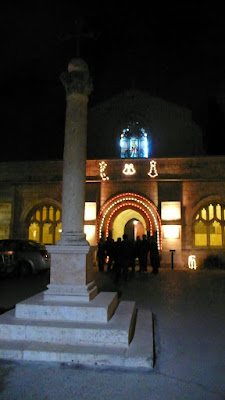
1. St George Cathedral, Jerusalem
This wasn't even on our itinerary, this is just a church across the road from the hotel where we stayed. And it was where a small bunch of us had our Christmas Eve service. It is an Anglican church. (This is not the first time I’ve been to an English speaking Anglican church, I’ve been to a few in the UK.)
Instead of listening to the babbling of the chairperson (chairperson saying whatever he wants to say is a regular occurrence in my church service, sadly), I just love the liturgy based service. The whole service was beautiful. Plus I love being able to kneel down during the prayers.
The prayers are simple and prepared. For Anglicans who are used to them, they may be boring, but for me, these simple prayers were powerful. “We pray for the sick… and those in Gaza...” when spoken slowly allowed myself time for reflection. They did what prayers should be doing. Instead of forcing God to do our will, they help me to align myself with God’s will, to reflect on how God’s kingdom could be here and now.
It’s especially poignant for me when they spoke about their ministries serving people in Lebanon, Syria, Jordan and Palestine, that’s when I thought this is what God’s kingdom would be like. Peace for all.


2. Church of St. Simon the Tanner
Let me start by posting the history I found on the web about this church. It's pretty much what I heard during the tour.
We had to change into a small van to get through this garbage town because our tourist bus simply could not fit into these alleys.


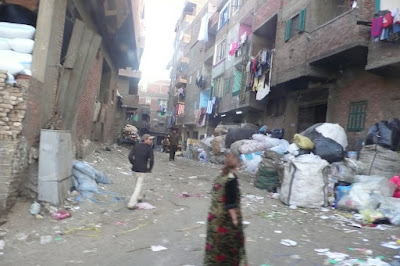
There’s a legend here Simon the Tanner’s prayer of moving the mountain was answered here, however, what struck me the most is the population they serve. Jesus served the poor, the oppressed, and the despised. However, in Hong Kong, most of the churches are typically middle class. The people who are poor, oppressed, despised simply weren’t being served by the church. When I visited this church, my first thought was that, this is what a church is meant to be like! And these people's world has been changed by this church, and this priest. This is what it meant for a mustard seed to grow into a big tree.


3. Of course, the good brothers and sisters I met on the trip are unforgettable!! We had a lot of fun together! And we had some deep sharing as well. And thanks to Facebook, we could keep in contact through the internet, and hopefully face-to-face soon. =)
When someone talks about Holy Land Pilgrimage, you may expect the most special part to be visiting places like Via Dolorosa. For me (it’s not exactly a pilgrimage for me anyway=P), it wasn’t Via Dolorosa, or any other places where Jesus or other Biblical characters had been to. (!)
1. St George Cathedral, Jerusalem
This wasn't even on our itinerary, this is just a church across the road from the hotel where we stayed. And it was where a small bunch of us had our Christmas Eve service. It is an Anglican church. (This is not the first time I’ve been to an English speaking Anglican church, I’ve been to a few in the UK.)
Instead of listening to the babbling of the chairperson (chairperson saying whatever he wants to say is a regular occurrence in my church service, sadly), I just love the liturgy based service. The whole service was beautiful. Plus I love being able to kneel down during the prayers.
The prayers are simple and prepared. For Anglicans who are used to them, they may be boring, but for me, these simple prayers were powerful. “We pray for the sick… and those in Gaza...” when spoken slowly allowed myself time for reflection. They did what prayers should be doing. Instead of forcing God to do our will, they help me to align myself with God’s will, to reflect on how God’s kingdom could be here and now.
It’s especially poignant for me when they spoke about their ministries serving people in Lebanon, Syria, Jordan and Palestine, that’s when I thought this is what God’s kingdom would be like. Peace for all.
2. Church of St. Simon the Tanner
Let me start by posting the history I found on the web about this church. It's pretty much what I heard during the tour.
I have heard tales of an amazing work taking place among the garbage workers of Cairo since I was an undergrad. So it was very encouraging to read this article from the February Lausanne World Pulse: Transforming Lives in Cairo's Garbage Villages.
Villagers collect garbage from city apartments and recycle it. They are the most despised group of people in Egyptian society. They are not paid by the government; however, they receive small tips from the people whose garbage they collect. The rest of their income comes from recycling garbage. It is one of the most ecologically efficient operations in the world as 90%of the garbage is recycled. But the human cost is terrible. Muqattam, now a thriving town of 30,000 began in 1970, when a community of several thousand Coptic garbage workers were forcibly resettled in an abandoned quarry at the foot of a small mountain.
Thirty years ago, Fr. Samaan, a Coptic Orthodox priest "gave up his job in the city to become an ordained priest in the garbage village. When he began, the village had no churches, schools, electricity, water, medical care or markets. It was just garbage, people and pigs. When thousands were brought to a saving faith in Jesus Christ, the first thing they wanted to do was build a church—and Father Samaan became their priest. Today, the garbage collectors are filled with love and motivation from God. This is what changed their village. The village is a bustling, hopeful community of thirty thousand people. They still collect garbage; however, they now have three schools, a hospital and many churches.
Blessing in Caves
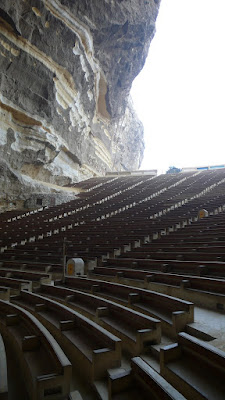
The churches are located in caves that were blocked by rubble. It was only when one small cave was discovered that residents realised they were surrounded by caves. While that first cave was being converted into a chapel, residents found another one that is now used for church services of up to four thousand people. They soon realised that another cave could be transformed into an enormous amphitheatre to seat fifteen thousand people. “Regular church services are held there and people come from all over Cairo—not just from the garbage village—to worship with other Christians,” Rebecca explains. “It is the only place, other than the Coptic Orthodox Cathedral, where Christians can meet in large numbers in Egypt.”
Father Samaan now pastors the largest church in the Middle East and one of the best known in Egypt: St. Simon the Tanner Coptic Orthodox Church in the Mokattam garbage village.
The cave churches have become something of a tourist attraction as you can understand when you see this series of pictures of this extraordinary place and its extraordinary community.We had to change into a small van to get through this garbage town because our tourist bus simply could not fit into these alleys.
There’s a legend here Simon the Tanner’s prayer of moving the mountain was answered here, however, what struck me the most is the population they serve. Jesus served the poor, the oppressed, and the despised. However, in Hong Kong, most of the churches are typically middle class. The people who are poor, oppressed, despised simply weren’t being served by the church. When I visited this church, my first thought was that, this is what a church is meant to be like! And these people's world has been changed by this church, and this priest. This is what it meant for a mustard seed to grow into a big tree.
3. Of course, the good brothers and sisters I met on the trip are unforgettable!! We had a lot of fun together! And we had some deep sharing as well. And thanks to Facebook, we could keep in contact through the internet, and hopefully face-to-face soon. =)
Tuesday, December 16, 2008
Systemic sins
From Brian McLaren's book-- Everything must change: Jesus, Global Crises, and a Revolution of Hope
Only a fraction of our sins are personal. By far the greater part are sins of neglect, sins of default, our social sin, our systemic sin, our economic sin. For these sins Christ died, and continues to die. For these sins Christ atoned, and continues to atone.... As long as evangelism presents a gospel centered on the need for personal salvation, individuals will acquire a faith that focuses on maximum benefits with minimal obligations, and we will change the costly work of Christ's atonement into the pragmatic transaction of a salvific contract.... The sanctifying grace of God in Jesus Christ is meant not just for the sinner but also for a society beset by structural sin.
Only a fraction of our sins are personal. By far the greater part are sins of neglect, sins of default, our social sin, our systemic sin, our economic sin. For these sins Christ died, and continues to die. For these sins Christ atoned, and continues to atone.... As long as evangelism presents a gospel centered on the need for personal salvation, individuals will acquire a faith that focuses on maximum benefits with minimal obligations, and we will change the costly work of Christ's atonement into the pragmatic transaction of a salvific contract.... The sanctifying grace of God in Jesus Christ is meant not just for the sinner but also for a society beset by structural sin.
Sunday, December 14, 2008
Consumerism
This is a reminder for me when I'm thinking about buying yet another new camera, coz my camera is kinda broken (still functional), but more because I WANT a new one...
From Lord to Label: how consumerism undermines our faith
Christian critiques of consumerism usually focus on the dangers of idolatry—the temptation to make material goods the center of life rather than God. This, however, misses the real threat consumerism poses. My concern is not materialism, strictly speaking, or even the consumption of goods—as contingent beings, we must consume resources to survive. The problem is not consuming to live, but rather living to consume.
We find ourselves in a culture that defines our relationships and actions primarily through a matrix of consumption. As the philosopher Baudrillard explains, “Consumption is a system of meaning.” We assign value to ourselves and others based on the goods we purchase. One’s identity is now constructed by the clothes you wear, the vehicle you drive, and the music on your iPod. In short, you are what you consume.
This explains why shopping is the number one leisure activity of Americans. It occupies a role in society that once belonged only to religion—the power to give meaning and construct identity. Consumerism, as Pete Ward correctly concludes, “represents an alternative source of meaning to the Christian gospel.” No longer merely an economic system, consumerism has become the American worldview—the framework through which we interpret everything else, including God, the gospel, and church.
When we approach Christianity as consumers rather than seeing it as a comprehensive way of life, an interpretive set of beliefs and values, Christianity becomes just one more brand we consume along with Gap, Apple, and Starbucks to express identity. And the demotion of Jesus Christ from Lord to label means to live as a Christian no longer carries an expectation of obedience and good works, but rather the perpetual consumption of Christian merchandise and experiences—music, books, t-shirts, conferences, and jewelry.
Approaching Christianity as a brand (rather than a worldview) explains why the majority of people who identify themselves as born-again Christians live no differently than other Americans. According to George Barna, most churchgoers have not adopted a biblical worldview, they have simply added a Jesus fish on the bumper of their unregenerate consumer identities. As Mark Riddle observes, “Conversion in the U.S. seems to mean we’ve exchanged some of our shopping at Wal-Mart, Blockbuster, and Borders for the Christian bookstore down the street. We’ve taken our lack of purchasing control to God’s store, where we buy our office supplies in Jesus name.”
......
As a result, choosing a church today isn’t merely about finding a community to learn and live out the Christian faith. It’s about “church shopping” to find the congregation that best expresses my identity. This drives Christian leaders to differentiate their church by providing more of the features and services people want. After all, in a consumer culture the customer, not Christ, is king.
From Lord to Label: how consumerism undermines our faith
Christian critiques of consumerism usually focus on the dangers of idolatry—the temptation to make material goods the center of life rather than God. This, however, misses the real threat consumerism poses. My concern is not materialism, strictly speaking, or even the consumption of goods—as contingent beings, we must consume resources to survive. The problem is not consuming to live, but rather living to consume.
We find ourselves in a culture that defines our relationships and actions primarily through a matrix of consumption. As the philosopher Baudrillard explains, “Consumption is a system of meaning.” We assign value to ourselves and others based on the goods we purchase. One’s identity is now constructed by the clothes you wear, the vehicle you drive, and the music on your iPod. In short, you are what you consume.
This explains why shopping is the number one leisure activity of Americans. It occupies a role in society that once belonged only to religion—the power to give meaning and construct identity. Consumerism, as Pete Ward correctly concludes, “represents an alternative source of meaning to the Christian gospel.” No longer merely an economic system, consumerism has become the American worldview—the framework through which we interpret everything else, including God, the gospel, and church.
When we approach Christianity as consumers rather than seeing it as a comprehensive way of life, an interpretive set of beliefs and values, Christianity becomes just one more brand we consume along with Gap, Apple, and Starbucks to express identity. And the demotion of Jesus Christ from Lord to label means to live as a Christian no longer carries an expectation of obedience and good works, but rather the perpetual consumption of Christian merchandise and experiences—music, books, t-shirts, conferences, and jewelry.
Approaching Christianity as a brand (rather than a worldview) explains why the majority of people who identify themselves as born-again Christians live no differently than other Americans. According to George Barna, most churchgoers have not adopted a biblical worldview, they have simply added a Jesus fish on the bumper of their unregenerate consumer identities. As Mark Riddle observes, “Conversion in the U.S. seems to mean we’ve exchanged some of our shopping at Wal-Mart, Blockbuster, and Borders for the Christian bookstore down the street. We’ve taken our lack of purchasing control to God’s store, where we buy our office supplies in Jesus name.”
......
As a result, choosing a church today isn’t merely about finding a community to learn and live out the Christian faith. It’s about “church shopping” to find the congregation that best expresses my identity. This drives Christian leaders to differentiate their church by providing more of the features and services people want. After all, in a consumer culture the customer, not Christ, is king.
Wednesday, December 03, 2008
He Loved Me
This hymn is probably listed among the top of my faves, maybe number one. It is based on based on Romans 8:35-39.
He chose me --- be-fore the world was known.
He chose me --- to be His very own.
He made me, then let me choose my way.
I chose to move a-way.
He loved me --- when hope had tak-en wing.
He loved me --- when I lost ev-'ry-thing.
He bought me, redemp-tion's work was done
though Jesus Christ, His Son.
Who-- shall sep-a-rate me from the love of God?
Shall dreams of to-mor-row,
pain, or sor-row,
Can the need of food or earth-ly pos-sess-ions,
the threat of war or man's op-pres-sion?
In all these things
vic-t'ry is our reward.
Vic-t'ry is our reward though Jesus Christ, our Lord.
#Of this I am sure,
that neither death, nor life,
nor angels, nor prin-ci-pal-i-ties,
nor pow-ers, nor things pres-ent,
nor things to come---
Not height, nor depth,
nor any crea-ture
Shall sep-a-rate me from the love of God.#
Through Jesus Christ, our Lord.
He chose me --- be-fore the world was known.
He chose me --- to be His very own.
He made me, then let me choose my way.
I chose to move a-way.
He loved me --- when hope had tak-en wing.
He loved me --- when I lost ev-'ry-thing.
He bought me, redemp-tion's work was done
though Jesus Christ, His Son.
Who-- shall sep-a-rate me from the love of God?
Shall dreams of to-mor-row,
pain, or sor-row,
Can the need of food or earth-ly pos-sess-ions,
the threat of war or man's op-pres-sion?
In all these things
vic-t'ry is our reward.
Vic-t'ry is our reward though Jesus Christ, our Lord.
#Of this I am sure,
that neither death, nor life,
nor angels, nor prin-ci-pal-i-ties,
nor pow-ers, nor things pres-ent,
nor things to come---
Not height, nor depth,
nor any crea-ture
Shall sep-a-rate me from the love of God.#
Through Jesus Christ, our Lord.
Subscribe to:
Posts (Atom)