Two of the reasons he has given are:
... The second thing that got me out of the traditional church has to do with what I felt to be the shallowness and superficiality of modern Christianity. According to my own frail assessment, contemporary Christianity is ten miles high and two inches deep. In fact, it’s so shallow that I question if a gnat could drown in it.
... Neglecting the Poor to Maintain and Enhance the Building
this is so true... sigh... read the rest here.
Wednesday, August 13, 2008

Tuesday, August 05, 2008
Reaching Out Without Dumbing Down: A Theology of Worship for the Turn-of-the-Century Culture By: Marva J. Dawn (Part 1)
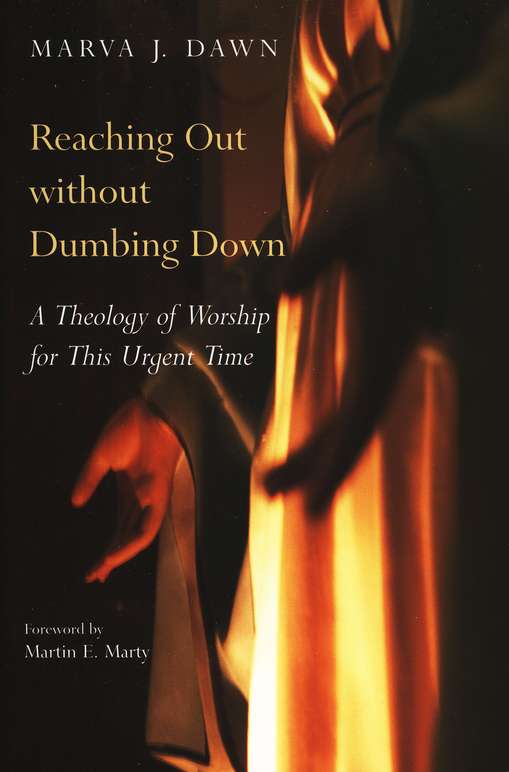
I am reading the Chinese translation of the book, but I managed to find almost all the parts I wanted from google books. =) I have finished 2/3 of the book, still 1/3 more to go, but I'll share it bit by bit.
From Reaching Out Without Dumbling Down
(I am a bit lazy to type this all up)
This is a book about worship, one with messages we need to hear. The standards of men/women dropped over the past decades, their ability to appreciate literary works, art whatever has declined.

And we sometimes try to get these people with "lower standards" to church by lowering the standards of worship in our church. That's where we got it wrong, worship is for God, not for us, or any other purposes.


We seldom acknowledge suffering in our worship, when we talked about suffering, we often talked about how God can help us, but in Psalms, the poets had a different way of expressing their feelings in their worship as Walter Brueggemann pointed out


Rikk Watts on Acts
I am taking a correspondence course from Regent on New Testament Foundations.
And when Rikk Watts talked about Acts,
Nothing can hinder this that God has determined to do.
(many examples from Acts) - nor the church in Jerusalem: whether leaders or corruption.
There is a crisis in my church, and this reminder that God is in control is reassuring.
And when Rikk Watts talked about Acts,
Nothing can hinder this that God has determined to do.
(many examples from Acts) - nor the church in Jerusalem: whether leaders or corruption.
There is a crisis in my church, and this reminder that God is in control is reassuring.
Why should I become a Christian?- I guess it can be "Why did I become a Christian (Part 4)?"
I remember trying to explain to my secondary school classmates why they should believe in Jesus? And then one said, "I am happy on my own, I don't need Jesus." We often think non-believers need Jesus, they have an emptiness inside, but many of them don't think they have.
Read more about this in the internetmonk blog.
And also an article from Times Online.
Nevertheless, young people do not feel disenchanted, lost or alienated in a meaningless world. “Instead, the data indicated that they found meaning and significance in the reality of everyday life, which the popular arts helped them to understand and imbibe.” Their creed could be defined as: “This world, and all life in it, is meaningful as it is,” translated as: “There is no need to posit ultimate significance elsewhere beyond the immediate experience of everyday life.” The goal in life of young people was happiness achieved primarily through the family.
...
“We live in an instant culture, which cannot be reached by instant missionary tactics.” And the desire for happiness is valid and should not be criticised by clergy. “It can only be outclassed by a Christ-like way of life, for in him alone is true happiness to be found.”
Monday, August 04, 2008
Heather King- I think this can also be "Why did you become a Christian (Part 3)"?
I just followed the link from internetmonk without even reading the whole thing he wrote and found this interview with someone named Heather King, and in the end, I found that the paragraph that I love is also quoted by internetmonk in his blog. =)
I think this is a the way Christianity should be, but she is talking about Catholicism. A pity "evangelicals" can't touch people's heart like this. Like what the internetmonk said, with a lot more real world application and more integrity with the main issues that are at stake with Jesus.
I just read the obituary of a woman named Irena Sendler, a Polish Catholic social worker who died at the age of 98, and who’d saved something like 2500 Jews, many of them children. The Nazis repeatedly tortured her, breaking her feet and legs, but she’d refused to give the names of her collaborators, or the location of the garden where she’d buried a jar containing a roll of paper with the names of the children and their parents. The Nazis finally let her go and as soon as she got out, she continued with her rescue work. You don’t have to be Catholic to be an Irena Sendler, but I can’t imagine anything that would encourage me more in that direction than Catholicism. Someone like Irena Sendler makes me realize how unworthy I am to call myself a follower of Christ: if I were really a follower, I’d live in a lot more courage, humility, poverty, chastity, and obedience than I do. But people like Irena Sendler give me something to strive for, to emulate. There’s something sublime about an Irena Sendler, about Catholicism, about a religion that makes saints out of sinners. Saints aren’t “good,” they’re beyond good, they’re part crazy. I read recently that faith means believing in the surprise ending. The Crucifixion was a surprise ending. You don’t expect the Savior of the world to die an apparent failure, rejected and scorned, spat upon, cut down in the prime of life and butchered—just like we don’t expect cancer, broken hearts, bankruptcy, alcoholism, war, lost children, famine, crime, and aging to cut us down like they do. So the Crucifixion was a surprise ending.
But the Resurrection—that’s the biggest surprise ending of all.
Also on a question almost everyone asks me, even my Catholic colleague, how come a Protestant like myself wears a cross with a crucified Jesus on it?? My answer is always "I love the one with Jesus dying on the cross more", of course, Heather King said it a lot more eloquently.
The cross in a Catholic church has a body on it. Right up front, right above the altar, is the message that subconsciously haunts us: someday, we’re going to die. Right up front, loud and clear, is the human condition: suffering, torment, conflict. As I say in Redeemed, the first time I went to Mass and really “saw” that body on the crucifix, I realized Christ isn’t saying that we need to suffer more; he’s acknowledging the suffering we’re already in. And I suppose on some level in that moment I “got” as much as I ever will, or as it’s possible to “get”—which is that God loves us so much he incarnated himself as man, he came down and pitched his tent among us to teach us how to come awake, to accompany us on the journey, to show what it looks like and what happens to you when you live in total integrity. Eventually, one way or another, they’ll kill you—which is why hardly anyone ever dares to live in total integrity.
And there is this one other question by the interviewer
Linda: Recently I sat for a time with someone with late stage Alzheimer’s and I remembered you once wrote that learning to just sit with someone in their own suffering is one of the greatest gifts and one of the most difficult to accomplish. It was helpful for me to realize I didn’t have to try to fix anything but that there was a purpose in just being there. Do you feel that grace lies in giving witness in that way, without any mirror for the ego?
Heather: Grace is a slightly overworked word that seems to mean different things to different people, but I think it requires grace, that is, the help of God, in order for our ego to “disappear” in the first place, in order for us to detach from our deep desire for results. We tend to value productivity, and to value ourselves according to how effective we are. Just sitting with someone in his or her suffering is difficult because our impulse is either to fix the person, or to be thanked, or both. If they can’t be fixed, we tend to lose interest; there’s nothing in it for us. The last thing Christ asked of his disciples was to sit with him, for his “hour” in the Garden at Gethsemane the night before he died—and of course, they couldn’t; like us, they fell asleep. It requires tremendous vulnerability, on the side of both parties, to simply sit quietly in each other’s presence. We feel we have to say something interesting or the other person will leave or get discouraged. So to get close enough to your own heart, and the heart of another, to realize, This is all I’ve ever wanted, for someone to sit with me. To love me just because I exist. To be in solidarity with my humanity and my suffering…
That’s big. I hope I make it there some day.Sunday, July 27, 2008
The Green Bible!

The Green Bible is printed on recycled paper and all the things about God's creation is highlighted in green. There are contributions from Brian McLaren, NT Wright, Desmond Tutu, and others.
Wow! If there are no highlights in green, I think I wanna get one... but I don't just want to read the "green" passages, so I need to think. (I was searching for NRSV Bible when I found this, coz I only have the NT NRSV at home...)
After reading more about it on Amazon.com, I'm seriously thinking about getting one... but I realise 10/7/08 means Oct, instead of Jul, so it's not available now, forgot about the American style for dates... sigh...
Wednesday, July 23, 2008
Why did you become a Christian?? (Part 2)
As mentioned in the previous post, at least one of the reviewers commented NT Wright's lack of mention on hell/sinning in his new book. I have a bit more on it today.
There's one chapter in Surprised by Hope on "Purgatory, Paradise, Hell". Sin was mentioned and NT Wright proposed a view on hell which is those who persist in sinning will end up in their dehumanization as they lost the image of God.
After he wrote about his proposed "hell", he did continue to say, "I am well aware that I have now wandered into territory that no one can claim to have mapped... The last I want is for anyone to supposed that I (or anyone else) know very much all about this. Nor do I want anyone to supposed I enjoy speculating in this manner... I should be glad to be proved wrong but not at the cost of the foundational claims that this world is the good creation of the one true God and that he will at the end bring about that judgment at which the whole creation will rejoice."
I think this is a reasonable proposal and he offered it in a humble way.
I do love the way he ended this chapter.
"But the most important thing to say at the end of this discussion... is that heaven and hell are not, so to speak, what the whole game is about. This is one of the central surprises in the Christian hope. The whole point of my argument so far is that the question of what happens to me after death is not the major central framing question that centuries of theological tradition have supposed. The New testament, true to its Old Testament roots, regularly insists that the major central framing question is that of God's purpose of rescue and re-creation for the whole world, the entire cosmos. The destiny of individual human beings must be understood within that context-- not simply in the sense that we are only part of a much larger picture but also in the sense that part of the whole point of being saved in the present is so that we can play a vital role within that larger picture and purpose. And that in turn makes us realise that the question of our own destiny, in terms of the altenatives of joy or woe, is probably the wrong way of looking at the whole question. The question ought to be, How will God's new creation come? and then, How will we humans contribute to that renewal of creation and to the fresh projects that the creator God will launch in his new world?...
Maybe we are faced with in our own day is a similar challenge: to focus not on the question of which human beings God is going to take to heaven and how he is going to do it but on the question of how God is going to redeem and renew his creation through human beings and how he is going to rescue those humans themselves as part of the process but not as the point of it all."
I think this is a rather good answer to the question I asked.
Tuesday, July 22, 2008
Why did you become a Christian?? (Part 1)
Last Sunday, someone asked a question about whether one can still recognises his/her family in heaven, because in the Bible, Jesus said, there won't be any marital relationship. And it is very difficult to convince people to believe in Jesus when they won't know their family/friends in heaven anymore.
My question is: Is Christianity only about getting to heaven??
It's just sad that so many people (EVEN CHRISTIANS) think that way.
I'm reading NT Wright's Surprised by Hope. I have read a lot of his stuff before, so most of the stuff in the first half of the book sounds familiar to me. =P
I agree with his view of heaven being on earth, rather than somewhere UP in the sky. I think most of the people who read his books agree with him on this. Most of the people don't like the political emphasis he had on this whole "heaven" business.
I haven't read through the application part yet, I had to read through the whole book because I got to introduce this "new" (I know it is not new, but most Christians don't know about it) heaven concept, and I think I have to be balanced and include the opposite views as well.
Someone on Amazon reviews said Wright did not mention much about sin, I don't know if he didn't mention it because he doesn't believe it is important in this whole business, or if it is because like what he said in the book, if a football commentator who doesn't talk about baseball, it doesn't mean he doesn't believe in baseball! Since so many people are talking about it, and so he didn't? I don't know.
I don't see why the removal of sin cannot co-exist with the new heaven and earth. Jesus' victory against sin is also part of it. hmm...
Got to figure out a way to present this whole complicated concept... and so many controversial points...
I've started listening to the lectures on New Testament Foundations I got from Regent College, Rikk Watts seemed to really agree on what NT Wright said about Israel stuff. hmm... I think I need to listen to some opposing views.
Saturday, July 19, 2008
Will of Power- thoughts an from the history of spiritual theology class and mp3 I got from church library
Spiritual discipline is a neglected tradition among evangelicals. Monks learned submission to God through submission to their abbots, and forfeit their own "rights" by obeying others. In this world and age, we often stress the importance of our right. Men are poor in their endurance and often have weak will of power to do what we need to do.
People who are weak in their will of power often have the following problems:
1. tardiness
2. breaking their promises
3. failing to resist temptations
4. laziness
5. failing to obey God
Post-modernity encourages
1. Consumerism (whatever we want, we can buy)
2. Sense of Control/patience (e.g. with MTRs, we don't need to wait for buses, with mobile phone, we can find anyone at anytime, with computer & internet, we can find information within seconds)
Some of the ways we use to practice in our daily life (that I think maybe useful for me)
1. Submitting to your family (to learn to forfeit our rights)
2. Stop watching TV for one week (to learn that we can live without certain things we think we need, but the fact is we can live without them)
(Thoughts and notes from the lectures on History of Spiritual Theology and the Baptist U lecture MP3 from Dr. Milton Wan)
I am weak in will power... maybe I should start practising...
Course materials received
Take a look at these... it costs me more than HKD 10000... they are sent by courier to me from Regent College for continuing studies...


Subscribe to:
Posts (Atom)